A Remote Monitoring and Management platform exists to perform administrative actions on many devices from one console. That is why an authentication flaw in an RMM platform should not be treated as the compromise of an isolated application. With CVE-2026-18577, access to N-able N-central became the starting point for reaching managed endpoints through a legitimate product feature.
What CVE-2026-18577 enables
The vulnerability is an authentication bypass using an alternate path or channel, classified as CWE-288. It results from an incomplete fix for CVE-2026-18556 and enables account takeover in N-central without credentials. N-able assigned a CVSS 4.0 score of 8.2 (CVSS:4.0/AV:N/AC:H/AT:N/PR:N/UI:N/VC:H/VI:N/VA:N/SC:L/SI:L/SA:L/E:A). NVD also provides a CVSS 3.1 assessment of 8.1 (CVSS:3.1/AV:N/AC:H/PR:N/UI:N/S:U/C:H/I:H/A:H). Both are High ratings, and CISA added the flaw to the Known Exploited Vulnerabilities catalog on August 3, 2026.
The official description avoids disclosing the specific technical path while the investigation continues. What has been confirmed is enough to size the risk: a remote threat actor obtained administrative access to N-central without authentication. This removes the boundary that should separate the internet from a tool specifically built to administer machines.
From the RMM console to managed devices
According to N-able, after entering N-central the intruder used the Take Control feature to connect to managed devices. The actor then registered Cloudflare tunnel services on those endpoints to maintain persistence even after console access was revoked. The chain matters: server exploitation, use of a legitimate administrative feature, and distributed persistence on the reached machines.
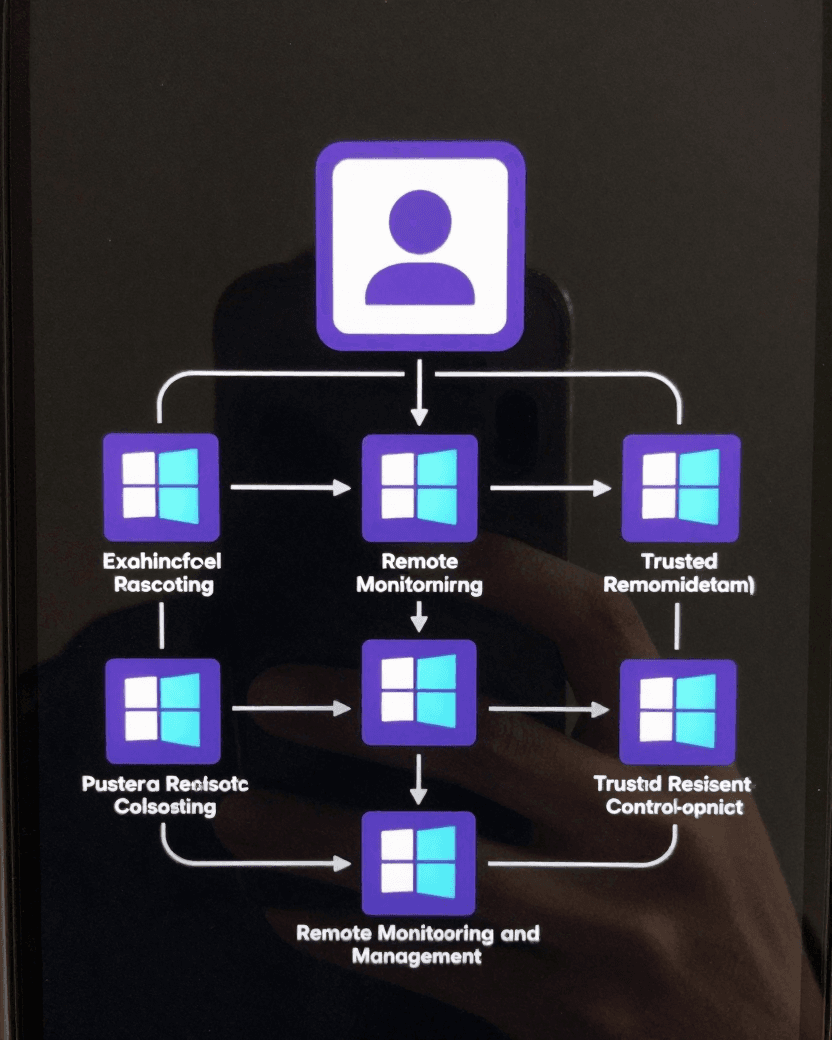
This pattern also changes how impact should be read. The base score describes the flaw in the product, but it does not know how many customers, servers, or workstations are connected to the instance. One console may represent dozens or thousands of already-authorized administration paths. The blast radius must be calculated from the real inventory, not from CVSS alone.
Hotfix 1 did not close the case
N-able released Hotfix 1, build 2026.3.1.7, on August 2. Continued monitoring found a related attack path, and the vendor released Hotfix 2, build 2026.3.1.10, on August 6. The second package supersedes the first and must be installed even in environments that already applied Hotfix 1. For N-able-hosted N-central, the vendor applied the mitigation. On-premises instances need to reach build 2026.3.1.10.
The sequence also leaves a validation lesson: confirming that an installer completed does not prove that the flaw class was eliminated. A retest looks for equivalent routes, flow variations, and alternate channels that preserve the same result. A related path was exactly what forced the second fix.
The patch closes entry, but it does not remove persistence
Official guidance says environments that were slow to apply the fix should be treated as potentially compromised. Published indicators include a file named svchost.exe inside a user's Documents folder, a registered service named Cloudflared, unexpected Take Control activity, suspicious logins, user creation, and unexplained password resets. The snippet below performs read-only defensive triage for the two most direct endpoint indicators.
$knownIps = @(
  '173.249.252.200', '185.156.46.150', '23.234.94.43',
  '37.153.90.88', '37.19.210.32', '68.235.46.214',
  '68.235.46.235', '87.249.138.34', '92.118.112.181'
)

# Known file indicator published by N-able
Get-ChildItem 'C:\Users\*\Documents\svchost.exe' -File -ErrorAction SilentlyContinue |
  Select-Object FullName, Length, CreationTimeUtc, LastWriteTimeUtc

# Known persistence service published by N-able
Get-CimInstance Win32_Service |
  Where-Object { $_.Name -eq 'Cloudflared' } |
  Select-Object Name, State, StartMode, PathName

# Current connections to the published IP indicators
Get-NetTCPConnection -ErrorAction SilentlyContinue |
  Where-Object { $knownIps -contains $_.RemoteAddress } |
  Select-Object LocalAddress, LocalPort, RemoteAddress, RemotePort, State
What to do now
- Upgrade every on-premises instance to Hotfix 2, build 2026.3.1.10, even if Hotfix 1 is already installed
- Enforce MFA on every account and disable the in-product support account when it is not needed for an open support case
- Audit new users, password resets, privileges, logins, and Take Control activity from before July 31, 2026
- Run the detection tool published by N-able and complement it with endpoint, network log, and EDR triage
- Investigate every indicator before removing artifacts and preserve evidence to determine which devices were reached
- Restrict console exposure to required administrative sources and review every access exception
- Rotate credentials and secrets accessible through N-central if there is any sign of unauthorized access
What to include in the next pentest
Administration tools belong in the scope as high-impact assets even when they do not host business data. Testing must cover authentication across every exposed path, segregation between customers and sites, operator privileges, the real reach of remote functions, credential protection, and the ability to detect anomalous console use. The decisive question is not only whether someone can enter the RMM. It is how many systems that person controls once inside.